Superfund Solutions Initiative: What’s Actually New?
On June 3, 2026, the Environmental Protection Agency (EPA) announced the Superfund Solutions Initiative, a “new,” long-term effort to speed up cleanup at contaminated Superfund sites across the country.
Sounds promising, right?
For communities that have waited years, sometimes decades, for contaminated soil, water, and waste to be addressed, any renewed focus on faster cleanup is welcome. But the real question is not whether the EPA has announced another initiative. The real question is: what will actually change on the ground?
EPA states the Superfund Solutions Initiative is organized around three main priorities: enhanced project management, earlier deployment of cleanup tools and legal authorities, and smarter science. In plain terms, the agency says it wants to move sites more quickly from investigation to cleanup, reduce risks sooner, and give communities more visible progress in real time.
That is an important goal. But it is also worth asking how EPA plans to do it.
What EPA says it will do
Under the first priority, enhanced project management, EPA says it will expedite investigations at more than 500 Superfund sites. This includes increasing targeted water, soil, and air sampling; conducting more timely inspections; and accelerating the development of remedial investigations, feasibility studies, and Records of Decision. EPA also says it will modernize site management practices and streamline its use of licensed contractors, which the agency says could reduce cleanup timelines by up to a year.
The second priority is deploying cleanup tools and legal authorities earlier. This means EPA would evaluate cleanup options under Superfund, the Resource Conservation and Recovery Act, the Brownfields program, and other available tools at the same time, rather than moving through one process at a time. It also means starting short-term projects that provide immediate protection (Time-Critical Removal Actions) while long-term remedies are still being developed (Remedial Actions).
The third priority is applying smarter science. EPA says this includes modernizing risk assessment approaches, using site-specific information to guide cleanup decisions, applying newer cleanup technologies, and assessing opportunities for critical mineral recovery at some legacy mining sites. EPA also points to recent developments in residential lead cleanup and PFAS treatment as examples of where updated science and technology could support faster, more protective outcomes.
So what does that actually mean?
At its core, the Superfund Solutions Initiative is not creating a brand-new cleanup law. It is not, based on the public-facing announcement, a new enforcement program, a new rule, or a new source of funding. Instead, it appears to package existing Superfund tools into a more aggressive management strategy.
Most of what EPA is describing is not new, but it is still meaningful. The authorities, cleanup tools, and technologies already exist. However, one aspect of the initiative does stand out: EPA’s focus on sequencing. Rather than introducing new tools, the agency is emphasizing a different way of using the tools it already has.
Traditionally, many Superfund sites move through a long, linear process: investigation, risk assessment, feasibility study, proposed plan, Record of Decision, remedial design, remedial action, and then long-term operation and maintenance. That process typically takes years. In many communities, it has taken decades.
EPA’s initiative suggests the agency will try to compress that timeline by doing more work earlier and in parallel. That could mean more sampling sooner, faster identification of contamination hotspots, more use of short-term removal actions, and earlier coordination across federal, state, Tribal, and local partners. It could also mean less “starting from scratch” at every site when EPA already has decades of experience with similar contamination problems.
That is where the initiative could matter. If EPA uses existing authority to act earlier, especially where there are clear exposure risks, communities could see protective measures sooner instead of waiting for the entire long-term remedy to be finalized.
But we have heard this before
This is not the first time EPA has promised to make Superfund faster.
Since Congress passed the Comprehensive Environmental Response, Compensation, and Liability Act, better known as CERCLA or Superfund, in 1980, the program has repeatedly been the subject of reforms, reviews, task forces, and acceleration initiatives. Some focused on enforcement. Some focused on administrative reform. Some focused on redevelopment.
In fact, when you look at comparable Superfund reform and acceleration efforts over time, EPA has returned to this basic idea again and again: the program is too slow, communities are waiting too long, and the agency needs to make cleanup decisions faster.
Superfund Acceleration Efforts
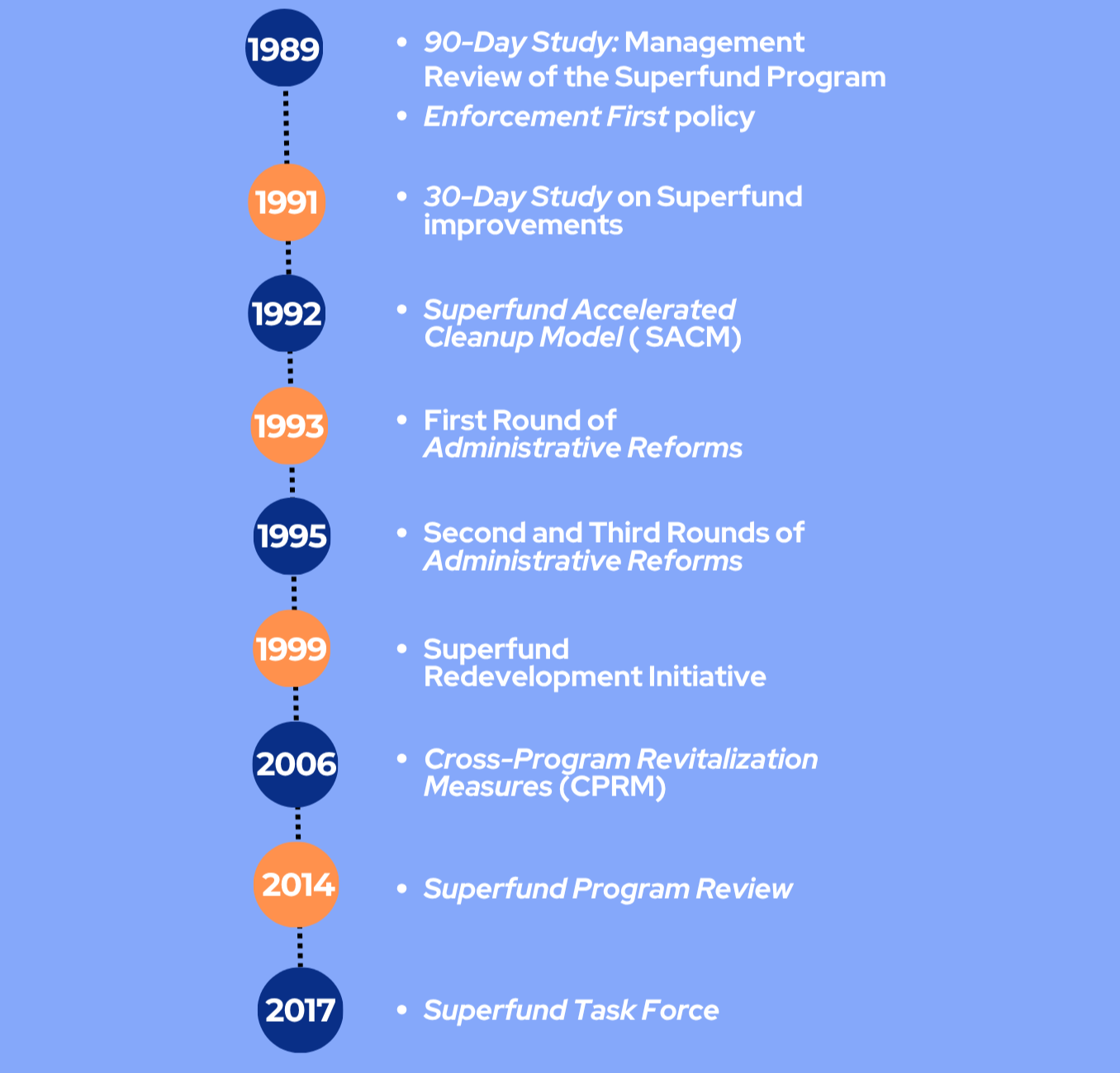
That history matters. The tools have existed for a long time. What has often been missing is the consistent political will, staffing, funding, enforcement pressure, and leadership needed to move contaminated sites through cleanup.
What will make this initiative real?
The Superfund Solutions Initiative will not be judged by the announcement itself, but by what happens next. What matters is whether EPA leadership is willing to make decisions that move sites through the cleanup process and protect public health and the environment. Over time, what has ebbed and flowed is not the existence of legal authority, but the willingness to use it: to hold polluters accountable, set firm deadlines, and stop kicking difficult cleanup decisions down the road.
Communities should begin to see action on the ground, not just metrics on a website. EPA should also be transparent about which sites are being prioritized, what deadlines are being set, and what happens when polluters delay or refuse to act.
Additionally, the initiative’s language about “streamlining” and “cutting red tape” should not become an excuse to weaken cleanup standards or limit community input. Faster cleanup must mean faster protection, not faster shortcuts.
Our take
We welcome EPA’s renewed focus on accelerating Superfund cleanups. Communities living near contaminated sites deserve urgency. They deserve clear timelines. They deserve cleanup decisions that protect public health and the environment.
In the Houston region, we have already seen signs of a more active approach from EPA.
In April of 2026, EPA issued a Unilateral Administrative Order for the San Jacinto River Waste Pits Superfund Site — eight years, or 3,121 days to be exact, after the Record of Decision was signed. After years of delays, that action signaled a meaningful change of pace. What happens next remains to be seen. Community involvement and pressure have been key to keeping this site moving so far, and they will continue to be vital in the next phase.
Other examples in the Houston region include the Highlands Acid Pits, where the ongoing threat of benzene has been known for years. EPA’s 2023 Five-Year Review included necessary recommendations to ensure the remedy be protective of human health and the environment over the long term. And despite longstanding concerns about potential exposure to nearby residential properties through groundwater and vapor intrusion, it wasn’t until earlier this year that EPA decided to install additional monitoring wells to better evaluate the current extent of contamination and determine whether the site poses a vapor intrusion concern for nearby properties.
At the Patrick Bayou Superfund Site, EPA recently hosted its first public meeting in several years. We are seeing the agency have a sense of renewed community involvement, as they’ve begun to publicly re-engage with stakeholders and community members. This site is contaminated with PCBs, mercury, polyaromatic hydrocarbons (PAHs), dioxin, lead, and bis(2-ethylhexyl) phthalate. Since 2006, the remedial investigation has remained ongoing. Now, 20 years later, EPA is evaluating a time-critical removal action that could move forward alongside the ongoing studies for a long-term remedy.
At the Jones Road Groundwater Plume Superfund Site, EPA determined in 2022 that open pathways existed for people to be exposed to chlorinated chemicals (PCE,TCE, DCE and vinyl chloride). But it was not until 2025 that the agency decided to redo the remedial investigation and feasibility study to determine where exactly contamination is today, and what can be done about it.
Taken together, these examples signal a more active approach by the agency, and showcase both the regulatory limitations and the promise and of the Superfund Solutions Initiative. The truth is, this initiative does not appear to create new enforcement authority or new cleanup tools. What it is, instead, is a promise to use existing tools sooner, more efficiently, and more aggressively. And we are seeing more community engagement and action from the agency than we have seen in many years.
The real measure of success, however, will not be announcements—it will be whether communities on the ground see shorter timelines, stronger accountability, and contamination safely removed. We hope communities across the country finally see the cleanup progress they have been promised for far too long.
P.S. We’d love to learn about what you are seeing in YOUR community. Have you noticed any developments in the toxic sites near you? Let us know in the comments!
Linked in the document
https://www.epa.gov/superfund/superfund-solutions-initiative
https://drive.google.com/file/d/1vLGEaN0abE6d58WkZYY2oAy4fJlNVfye/view?usp=sharing
https://cumulis.epa.gov/supercpad/cursites/csitinfo.cfm?id=0602505https://cumulis.epa.gov/supercpad/cursites/csitinfo.cfm?id=0605329
https://cumulis.epa.gov/supercpad/cursites/csitinfo.cfm?id=0605460
https://www.epa.gov/superfund/superfund-history-printable-version
