Northeast Houston Coalition
Houston, Texas
Northeast Houston, especially the Greater Fifth Ward and Kashmere Gardens, are experiencing a health crisis brought on by years of industrial growth followed by decades of neglect.
THEA helped establish the Northeast Houston Coalition to support community-led efforts to better understand and address legacy contamination, environmental health concerns, and long-term wellbeing.
Cancer Clusters
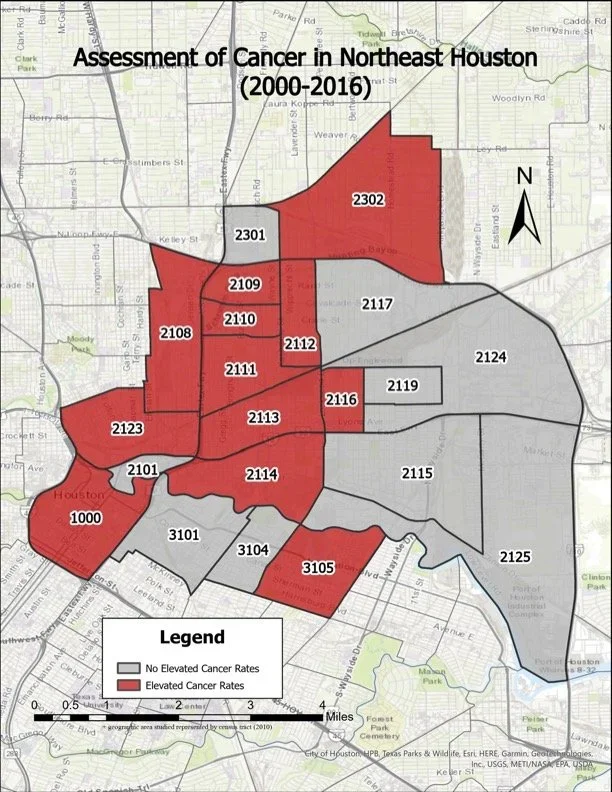
In 2019 an assessment by Texas Department of State Health Services (DSHS) found abnormally high rates for seven different types of cancer in the Greater Fifth Ward, including four that attack the respiratory system. In Kashmere Gardens, childhood leukemia rates were five times greater than the state’s average.
The problem is that the studies don’t go far enough. THEA’s research determined that leukemia was the only childhood cancer the state looked into.
THEA joined with local residents to request a comprehensive health assessment of the area and encouraged a holistic response to community health and wellbeing concerns.
What Are The Area Hot Spots?
-
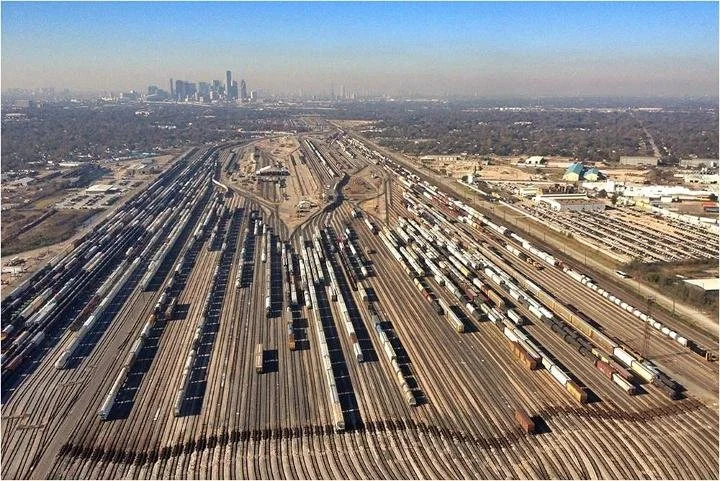
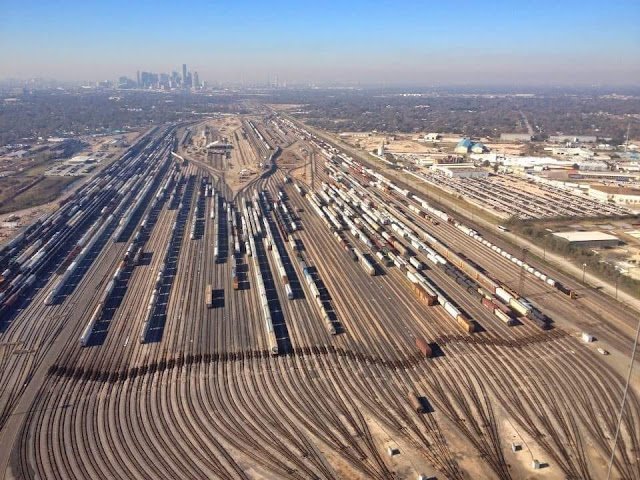
“No one knew.” That’s what residents living alongside the railroad tracks say about the site where workers would treat wooden ties with creosote and toxic chemical extenders. Today, we know the Greater Fifth Ward/Kashmere Gardens neighborhood has been found to be a cancer cluster. In 2022, Houston Health Department officials took samples from 47 places around the neighborhood and found cancer-causing dioxin in every sample.
-
For 15 years, the Houston Creosoting Company treated wood products at this location before closing and entering foreclosure in 1961. More than 40 years after being added to the National Priorities List, the site remains under EPA oversight. Although contaminated waste has been capped and stabilized, monitoring continues for 32 toxic chemicals today.
-
Less than a half mile away from the North Cavalcade Superfund Site, the South Cavalcade site tells a similar story of long-term contamination from historic wood-treatment operations. The property dates back to the early 1900s, and Koppers Company, Inc. later used the site to distill coal tar and treat wood with creosote and metallic salts. South Cavalcade has been on the National Priorities List since 1986. While an EPA-mandated remediation plan is in place, contaminated groundwater continues to be pumped from around the 66-acre site and must be continuously monitored to prevent it from seeping beyond the site boundaries.
Census data indicates that more than 40,000 people live within three miles of these three sites alone. Researchers at Rice University and other universities identified many other abandoned relic industrial sites in the area that have yet to be determined safe and free of harmful contaminants.